
Turn Raw Data into Decisions
LiDAR360
AI-empowered LiDAR and photogrammetry processing software. Process less. Scale effortlessly.
From Data to Decisive Intelligence
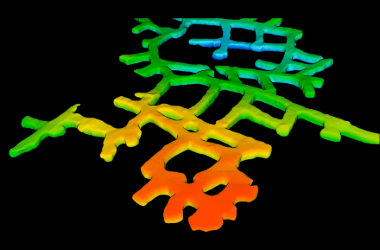
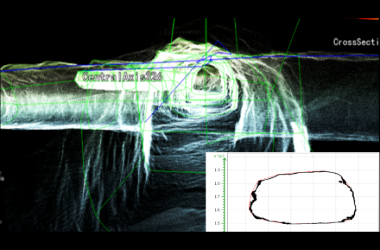
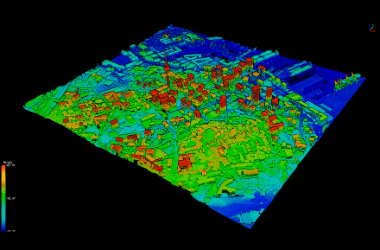
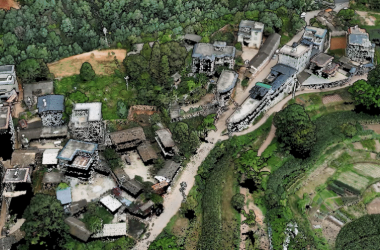
GreenValley LiDAR360 software transforms raw LiDAR and photogrammetry data into structured, decision-ready intelligence. Capturing data is only the beginning—true value comes from making it usable. It brings processing, analysis, and output together into one unified system, removing fragmented tools and disconnected workflows. AI-driven automation handles classification, extraction, and modelling with precision, turning complex datasets into clear, actionable insights. As workflows accelerate, accuracy and consistency follow. From capture to outcome, every step moves seamlessly toward decisions.
Key Features
Multi-Source Data Fusion

Massive Data Support

User-Friendly

Multi-Industry

One-click Operation

Custom Workflow

Batch Processing

Universal Platform
Multiple Platforms and Data Sources Support
| Multiple Platforms | Multiple Formats | Multiple Data Sources |
|---|---|---|
| HLS | Point Cloud | Point Cloud |
| ALS | Aerial Triangulation | Visible Light Image |
| UAV | Trajectory | Infrared Image |
| TLS | Vector | Hyperspectral Image |
| MLS | Raster | Remote Sensing Image |
Automatic AI Classification
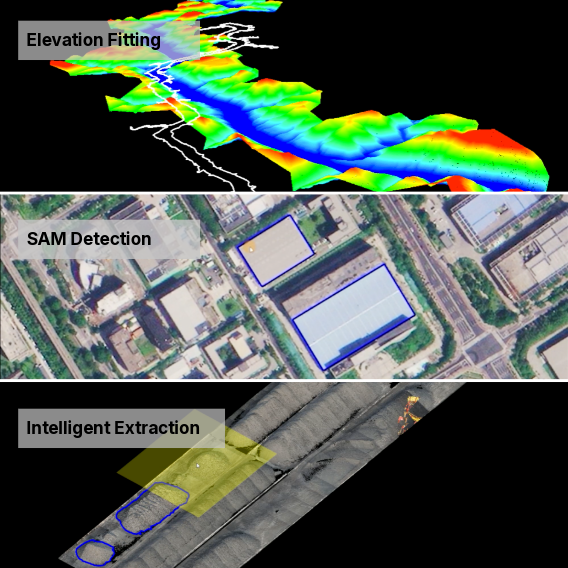
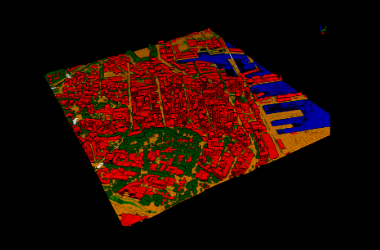
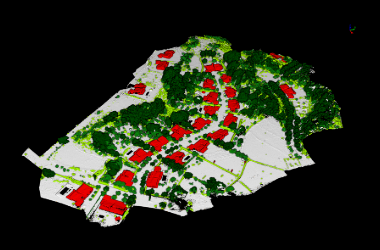
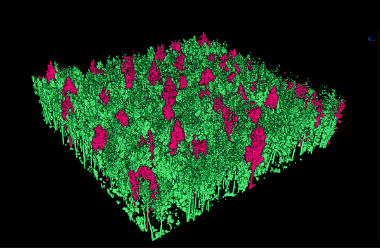
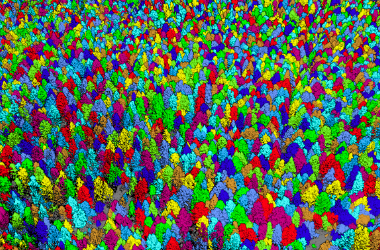
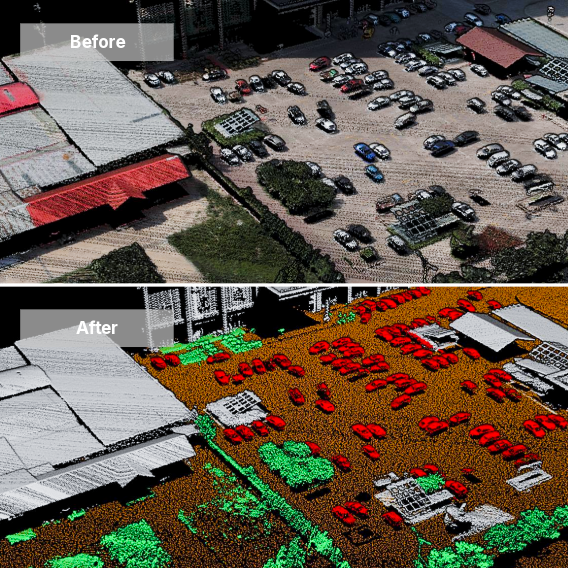
The classification module deeply integrates AI technology, allowing automatic classification for over 32 features. Integrating the Segment Anything Model, supporting outline extraction for arbitrary features from images.
Intelligent point cloud classification interactions make data processing more convenient and efficient.
Also, customised training of AI models for point cloud classification and image feature extraction meets the automation production needs of various applications.
Interactive refinement tools allow rapid validation and optimisation of classification results. This accelerates large-scale processing workflows while maintaining consistency across diverse datasets.
Model Builder
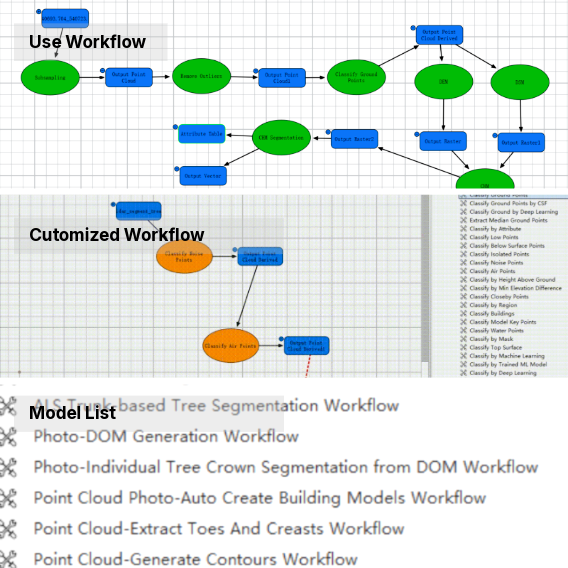
The Model Builder supports the free combination of over 200 functional modules to address more business scenarios; it supports distributed and command-line operations, enabling efficient construction and automated workflows.
Its modular architecture allows users to customise and scale solutions based on project complexity.
Seamless integration with existing systems and data pipelines enhances productivity, reduces manual intervention, and accelerates time-to-insight for critical decision-making.
Reusable workflow templates help standardise operations, ensuring consistency and efficiency across recurring projects and large-scale deployments.
Preprocessing
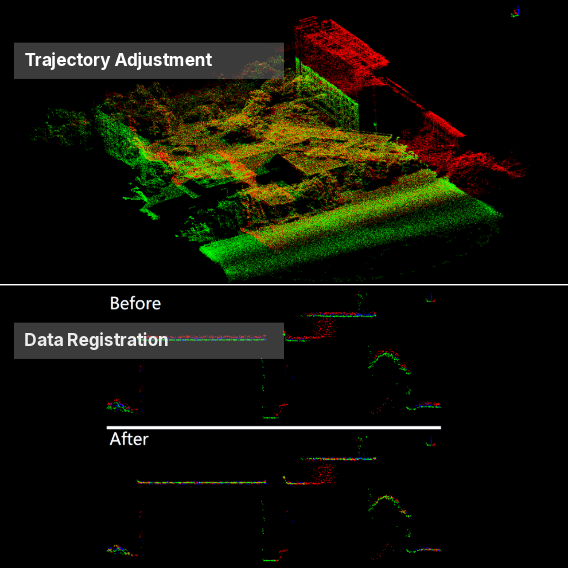
Every dataset begins raw and unstructured. LiDAR360 refines it through alignment, calibration, and noise correction. Multi-source data is brought together into a unified spatial framework, ensuring data consistency and quality from the start.
Flight path deviations and trajectory errors are corrected as the system builds a clean, reliable base. Data registration automatically aligns multi-station scans without manual stitching, and colour adjustment restores the point cloud’s true colours.
Coordinate systems can also be defined or transformed seamlessly, ensuring compatibility across different data sources and project requirements.
With accuracy established early, everything that follows becomes faster and more precise.
Photogrammetry
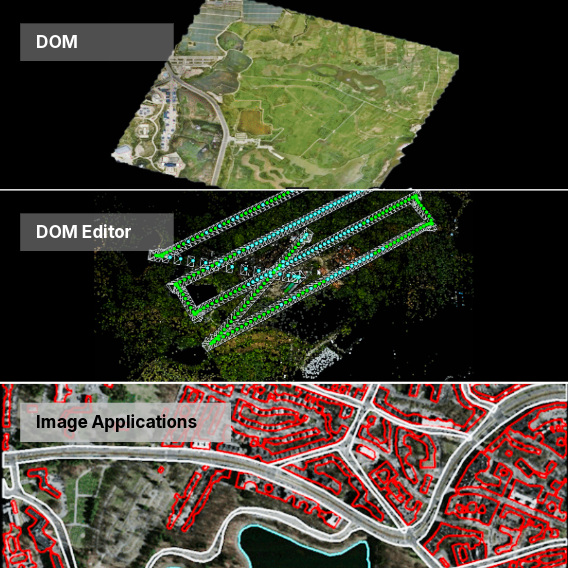
The new Photo module can create RGB, infrared, and multispectral orthophotographs.
Building on this foundation, imagery and LiDAR are fused to add depth and visual context. High-quality orthophotos and feature matching enhance how data is seen and understood.
Ground control points further improve accuracy across large-scale environments.
Automatic target detection further streamlines the processing workflow, while built-in editing tools ensure smoother map creation and feature extraction.
What emerges is a richer dataset that is clearer, more detailed, and easier to analyse.
Vectorization
The vector module supports collaboration of multi-source data. The processed data is converted into structured, machine-readable outputs by seamlessly integrating CAD and GIS files.
Features outlines are systematically extracted from point clouds/images by SAM, geometries are defined, and entities are translated into accurate vector datasets and 3D models.
Automated algorithms streamline extraction and reduce manual intervention across the pipeline. This enables faster integration with mapping, analysis, and modelling workflows.
The complex point cloud data is now transformed into standardised, analysable formats ready for downstream applications and decision systems.
Distributed Computing
The Distributed Computing supports multi-task parallel scheduling and flexible utilisation of cloud/local clusters for efficient processing. The distributed architecture splits tasks across multiple nodes, eliminating reliance on a single machine. Compared to traditional methods, this approach delivers multiple times higher efficiency. Seamlessly integrated with workflows, it helps complete professional tasks with lower hardware costs and faster processing times.
| Device Configuration | Function | Data | Compute Nodes Number | Efficiency Improvement |
|---|---|---|---|---|
| System: Windows 10 CPU: 11th Gen Intel i7 GPU: NVIDIA RTX 3050 | Image alignment | 6947 photos | 4 | 713% |
| Smooth + Subsampling + Remove Outliers + Classify Ground Points | 30GB point cloud | 4 | 168% | |
| 5 | 278% | |||
| 6 | 375% |
Turn raw data into decisions, seamlessly. Now transform your raw LiDAR and photogrammetry data into structured, decision-ready intelligence, bringing clarity, speed, and precision across every application. Unlock its true value and turn insights into impact.
Ready to transform your LiDAR and photogrammetry Data?
With Mirai, transform your complex datasets into clear, actionable insights with speed and precision.